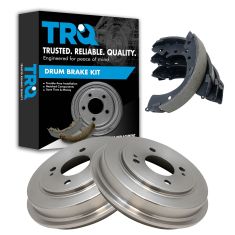
Replaces






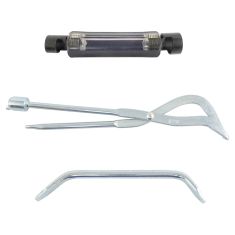
Frequently bought together
Part Details
About TRQ:
TRQ is a trusted brand dedicated to making every repair a success story by combining premium parts with easy installation. Each TRQ part is engineered by a team of automotive experts to meet or exceed OEM standards, delivering enhanced performance and maximum longevity. With rigorous in-house testing, the brand ensures superior fit and function across every product line. TRQ also provides customers with best-in-class, step-by-step installation videos—so you can complete repairs with confidence, whether you're a first-time DIYer or an industry professional.
Attention California Customers:
 WARNING: This product can expose you to chemicals including Lead and Lead Compounds, which are known to the State of California to cause cancer, and birth defects or other reproductive harm. For more information, go to www.P65Warnings.ca.gov.
Lifetime Warranty
This item is backed by our limited lifetime warranty. In the event that this item should fail due to manufacturing defects during intended use, we will replace the part free of charge. This warranty covers the cost of the part only.
FREE Shipping is standard on orders shipped to the lower 48 States (Contiguous United States). Standard shipping charges apply to Hawaii and Alaska.
Shipping is not available to a P.O. Box, APO/FPO/DPO addresses, US Territories, or Canada for this item.
Expedited is available on checkout to the United States, excluding Alaska, Hawaii.
Final shipping costs are available at checkout.


Created on:
Tools used
Tools used
Brought to you by 1AAuto.com, your source for quality replacement parts and the best service on the Internet.
Hi, I'm Mike from 1A Auto. I hope this how-to video helps you out, and next time you need parts for your vehicle, think of 1AAuto.com. Thanks.
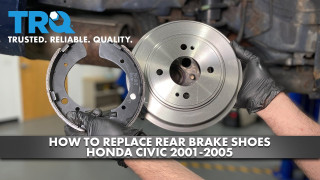
In this video we're going to show you how to remove and reinstall the rear brakes on this 2003 Honda Civic, pretty much the same as any 2001 to 2005 Civic with the rear drum brakes. The brakes are actually pretty good in this vehicle so we just show you how to take them apart and put them back together. We do one side. Obviously, you always want to replace your brakes in pairs.
The tools you'll need are a jack and jack stands, a tire iron, or a 19mm socket with a breaker bar, or even you could use your ratchet with a piece of pipe for some leverage just to get the lug nuts started, some needle nose locking pliers, and a torque wrench.
These lug nuts are 19 millimeters. You can either use a socket with a breaker bar or your tire iron. If you don't have the benefit of air tools, you'll want to start with your wheel on the ground. We'll loosen the lug nuts first. Then raise and support your vehicle and remove the wheel and tire. Just speed it up here as I remove the wheel and tire. Hopefully, your brake drum will come right off.
You see these springs right here, now there are special tools that you can use to get these apart. If you own a garage and work on cars all the time, it might make sense, but it also could make sense to buy a tool like this that has many uses. It's a locking jaw or vice grip pliers that has kind of a needle nose to it. Get it in there, lock it onto that spring, pull the spring over and release it. There's also a spring right here that's much easier. Pull it down and release it. Before you go too far, push your piston back in here and just lock this rubber boot back on. Just kind of pry it and pull it up and over. Pull it up and over, and then just kind of rotate it around as you push it right on. Change the size of your pliers here. You push on this little tab. Push it in, twist and let that out. Do the same thing on this side. It should untwist. Let that off. Your front shoe comes off. Rear shoe comes off, and the rear shoe is connected to the brakes here, the emergency brake cable. We just have to take this off. Right down here, your rear shoe is connected to your emergency brake cable. Pull it forward on the spring. Then pull your cable through like that. If you were putting on new shoes, what you would want to do is take this apart here. You basically just spread this clip apart, slip it off and then this arm comes off of the back shoe. You would want to put it onto the new shoe that you install, obviously, and then the reinstallation is just pretty much a reversal of the procedure. It's kind of upside down here. Clip the arm in place. Just slide that right down and in. Put the rear shoe up and in.
Before I go to reinstall that, I use a little bit of white grease right here on these contact points. There's three in the back and three in the front.
I've already got to get my clip on here. Put the shoe up into place and lock that on. This is the separator bar. It's what adjusts so you want to make sure this is all nice and free. This spins on there and that spins easily inside there. That goes right in there. Now you take your front shoe you put the spring on. Put it on down here. This shoe should be pushed right in there and then this one goes in behind. There's a little bracket that's holding the bottoms of them on. Pull our stud back. Make sure this goes into place. Now take your clip for the front shoe and make sure the front shoe is up in place. Hold the pin on the back side of the backing plate and then push the clip in and turn it. Rotate it with the pliers to lock it on.
Now you want to push these together. This little bracket goes right in there. I'll just show you that bracket from the other side so you can see. We'll put that there and stretch it right across. Put it in there. Make sure you push it right in. This spring goes right in. It goes on there and down into there.
Reinstall the rear brake drum. Then really kick it into high gear as I put the wheel on. Then on this vehicle you put the hub cap on, start the lug nuts and then preliminarily tighten them with either your ratchet or in this case my impact wrench. Then I'll torque them when the vehicle is on the ground. Then once the vehicle is on the ground, then torque your lug nuts to 100 foot pounds kind of using a crossing pattern as you go. Last, but certainly not least, always make sure you pump the brake pedal a bunch of times. Firm it up. Make sure the brakes are working correctly before you road test the vehicle.
We hope this helps you out. Brought to you by www.1AAuto.com, your source for quality replacement parts and the best service on the Internet. Please feel free to call us toll-free, 888-844-3393. We're the company that's here for you on the Internet and in person.
Tools used
Brought to you by 1AAuto.com, your source for quality replacement parts and the best service on the Internet.
Hi, I'm Mike from 1A Auto. I hope this how-to video helps you out, and next time you need parts for your vehicle, think of 1AAuto.com. Thanks.
In this video, we're going to show you how to do your rear brakes. This vehicle is a 2003 Civic with rear drum brakes. They're also the same for 2001 to 2005. We show you the passenger side. The driver's side is the same procedure. You'll need new brake kit from 1AAuto.com, 19mm socket or tire iron, needle nose and standard pliers, needle nose vice grips, flat head screwdriver, chisel and hammer, and jack and jack stand.
Raise and support the vehicle. Remove the tire.
Corrosion often builds up between the wheel hub and the drum brake. You may have to hit it with a hammer to get it to loosen up and come off easily. Always be sure not to hit the wheel studs. Just a little bit of tapping so we can get our hands behind it and the drum comes off. Repeat these steps on the opposite side of the vehicle. Work to disassemble and reassemble the rear drum brakes one side at a time, that way if you get lost or don't remember where something goes, you have the opposite side as a reference.
Using a small pair of needle nose vice grips or a brake spring tool, if you have one available to you, remove these springs from the drum brakes. Be sure the vice grips are on there good and tight, because these springs can slip out under tension. Remove the brake shoe retainers by supporting the back of the pin, pressing down with the screwdriver, and turning the retainer off of the pin. Remove your brake shoes and your retainer pins from the back of the dust shield. Repeat for the other side.
Remove your adjuster and allow the rear shoe to hang on the E-brake. Rotate the E-brake shoe so you can access the end of your E-brake cable. Grab onto it with you vice grips. Push back and remove the cable from its retainers.
In order to remove the E-brake spreader, you'll have to undo this horseshoe clip. There's a few ways to do this. You can try to wedge it with a screwdriver, pry the ends off, and push it through with pliers. Once you get the end spread out a little bit, you can set a pair of pliers to the back of the stud and the bottom of your clip. Remove the washer and the E-brake spreader from your shoe.
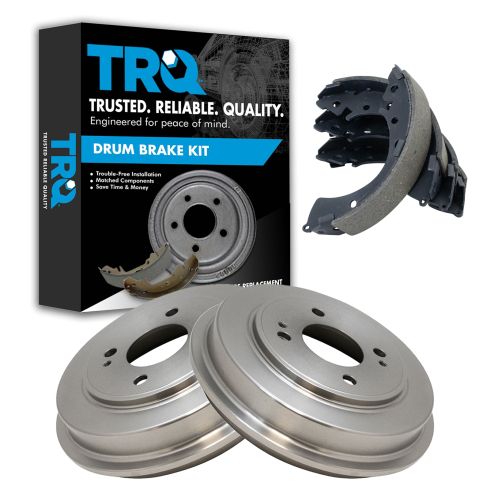
The original one from the vehicle. The new one from 1A Auto. Exact replacement. The shoes you can see here are the originals. This one's fairly worn out. The new ones from 1A Auto are an exact replacement.
The installation kit comes with the two springs, the mounting studs, as well as the clips, and the emergency brake holding clip. We're going to reuse our E-brake spreader, pin, and washer. Put it together with a new horseshoe clip that was included in our brake hardware kit. Install the pin into the brake shoe. Lay the E-brake spreader over the pin, washer, and slide your horseshoe clip into the groove. Close it up with needle nose vice grips or pliers. Make sure the ends are crimped together nice and tight.
Use a pair of needle nose vice grips to secure the end of your E-brake cable. You're going to want to push the spring back with this hook on your E-brake spreader. Slide it back. The lower brake spring hooks in from the back of the shoe. We'll hook it in to our rear shoe, making sure to lock the top into the wheel cylinder.
Feed our retainer pin to the back. Install your retainer clip over the pin. Press it down either by hand, with pliers, or the help of a flat-head screwdriver. You can use pliers to push the clip down. Grab your pin and rotate it.
Install the lower spring into your front pad. Be sure to hook it under the tab at the bottom. Install your retaining pin and clip the same way you did on the other side. Make sure your star wheel on your adjuster is spun all the way down with the longest leg facing you. Your adjuster arm will install with this adjuster sitting over this lip. Hook the retainer spring. Install your vice grips nice and tight.
We're going to install this hook into this hole. Install your vice grips nice and tight, so the spring is under a good amount of pressure. You don't want it snapping back at you. Sometimes, if it becomes partially engaged, you can tap it the rest of the way in with a screwdriver and a hammer.
Aligning this hole in the hub, you can access the star wheel with a screwdriver in order to adjust out your brake shoes. After you've adjusted your shoes up, you'll want to test fit your brake drum until you can just feel your brake shoes dragging on the wheel. This may take a few tries. Just a little bit of contact is all you need.
Reinstall the wheel. Your four 19mm lug nuts. Torque your four lug nuts to 84lbs in a cross pattern.
Thanks for tuning in. We hope this video helped you out. Next time you need parts for your car, please visit 1AAuto.com. Also check out our other helpful how-to and diagnosis videos.

BKA10465