Replaces




Frequently bought together
Part Details
About TRQ:
TRQ is a trusted brand dedicated to making every repair a success story by combining premium parts with easy installation. Each TRQ part is engineered by a team of automotive experts to meet or exceed OEM standards, delivering enhanced performance and maximum longevity. With rigorous in-house testing, the brand ensures superior fit and function across every product line. TRQ also provides customers with best-in-class, step-by-step installation videos—so you can complete repairs with confidence, whether you're a first-time DIYer or an industry professional.
Product Features
Attention California Customers:
 WARNING: This product can expose you to chemicals including Lead and Lead Compounds, which are known to the State of California to cause cancer, and birth defects or other reproductive harm. For more information, go to www.P65Warnings.ca.gov.
Lifetime Warranty
This item is backed by our limited lifetime warranty. In the event that this item should fail due to manufacturing defects during intended use, we will replace the part free of charge. This warranty covers the cost of the part only.
FREE Shipping is standard on orders shipped to the lower 48 States (Contiguous United States). Standard shipping charges apply to Hawaii and Alaska.
Shipping is not available to a P.O. Box, APO/FPO/DPO addresses, US Territories, or Canada for this item.
Expedited is available on checkout to the United States, excluding Alaska, Hawaii.
Final shipping costs are available at checkout.
Created on:
Tools used
Brought to you by 1AAuto.com, your source for quality replacement parts and the best service on the internet.
Hi, I'm Mike Green. I'm one of the owners of 1A Auto. I want to help you save time and money repairing and maintaining your vehicle. I'm going to use my 20 plus years experience restoring and repairing cars and trucks like this to show you the correct way to install parts from 1AAuto.com. The right parts installed correctly, that's going to save you time and money. Thank you and enjoy the video.
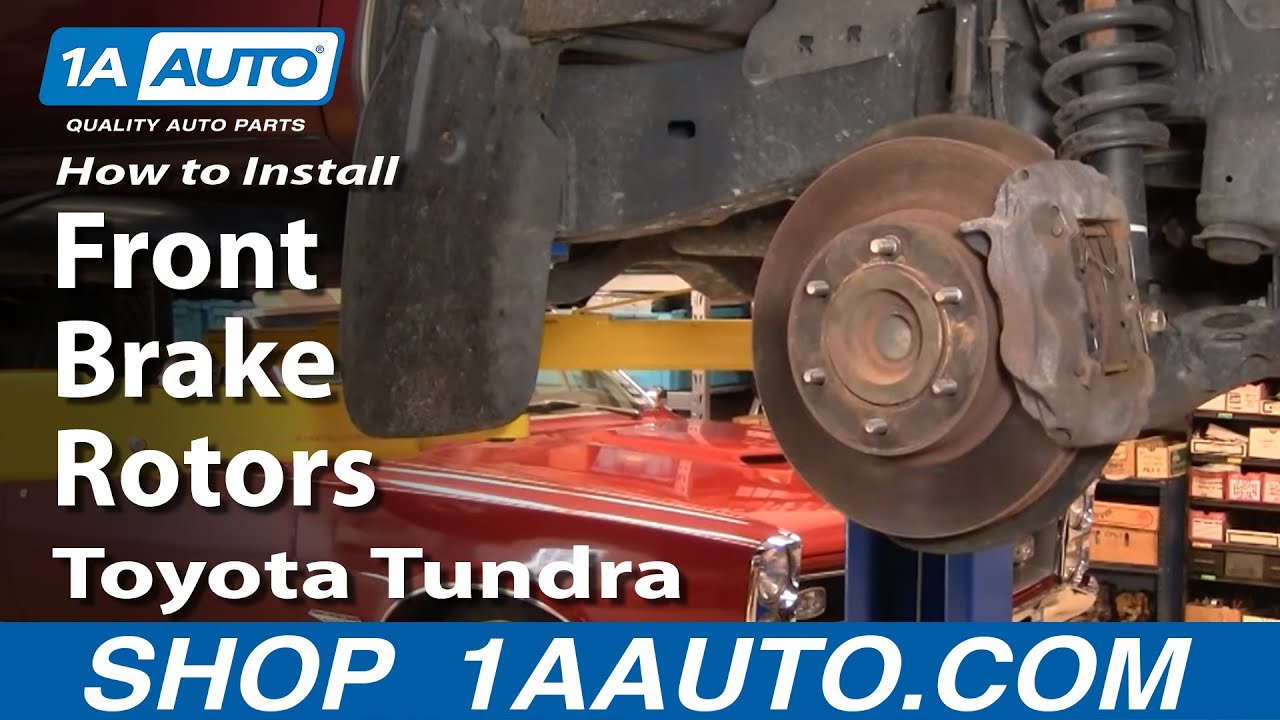
In this video, we're going to show you how to take apart and put back together the front brakes on this 2002 Toyota Tundra, same as most trucks of this era. This vehicle doesn't actually need any new brakes, so we don't replace them, but we do just show you how to take them apart and put them back together. Tool's you'll need are jack and jack stands, 21mm socket with a ratchet or a tire iron, a pipe or a breaker bar for some leverage, regular screwdriver, medium and large sizes, pliers, and a 17mm socket.
Start by using a flat blade screwdriver and sharply pry off your center cap. If you don't have the benefit of air tools, you'll want to loosen the lug nuts while the wheel's still on the ground. Then, raise and support the vehicle and loosen and remove the lug nuts the rest of the way. Fast forward here a little bit. I take the lug nuts off. The wheel is kind of stuck onto the hub. What I end up doing is actually just hitting it from one side from the top and the other side from the bottom and it breaks loose. You can see that there's still really good life left on the pads here. Also, the rotors are in good shape. I'm probably just going to end up taking this apart and putting it back together so you can see how it's done.
If you're just looking to change your pads, what you want to do is take a large screwdriver and force it in here. This is going to turn while I'm prying. Basically, as I'm prying, what I'm doing is I'm forcing these pistons back into the caliper. Turn It all the way. Now I'm going to do it for the other side here too. I'm pulling the wheel over and you can already see that there's some play in there. You pry out on this side and that forces these pistons back in. Now, you can see that there's these pads are nice and loose. Take your screwdriver, push down, on this little tab, pull this out, and this whole clip comes right out. Push your pins out a little bit. Use a pair of pliers, twist and pull the pins at the same time.
There's another little wire. Pull this right out. Use your pliers again. Grab hold of the pads and pull them right out and do the same thing to the front one. When you check your brakes, always make sure you check both sides. I already did check the other side. It's still in good shape. You can see our rotor. It's in really good shape, so I'm not going to replace them, but I am going to show you how to take them off. What you want to do at this point is remove these two bolts. One here and then one down here and they're on the inside of your caliper. Before you remove those bolts, you want to take a screwdriver and pry this clip right out. Once you get that clip out most of the way, use your pliers again.
These bolts are 17mm, so first I'll just try with my ratchet. You may want, if you need a little more leverage, use your pipe and that pulled down nice and easy and breaks the bolt loose. I'm going to fast forward here as I remove that lower bolt. Then, use the wrench and the pipe again to get the upper one and take them almost all the way out. As you pull the last few threads of these bolts out. I'm just laying the bolts to the side. Do this very, very carefully. Pull your caliper up and then, again, carefully. Now you want to just be careful not to bend that hose at all. Over here, remove your brake rotor.
Like I said, this brake rotor's in great shape so I'm not going to replace it. Put your new brake rotor on. Do all of that. Thread these bolts in a little bit so everything's held in place. Tighten them up. Speed it up here again as I just use the wrench and I'm going to tighten those up preliminary and then torque them afterwards. Torque wrench. I'm going to torque these bolts to 100 foot-pounds. Take that little clip. It goes in with this edge facing out. We'll put the pads back in. Once you have that stuff all in, you're going to put this wire retainer in. Push that in there. Take your upper pin and you want to make sure that you have it so the holes face the right way so you can get this retainer back in easily. Put it through.
It requires a little bit of tapping here. Turn those pins a little bit and now put it in and up here. Going to fast forward here as I put the wheel back on and then I hand thread on the lug nuts. You want to make sure you hand thread them on first so you don't cross the threads at all. Now, here I'm just tightening up the lug nuts preliminarily with the impact wrench and then I'll go back and torque them when the vehicle's on the ground. Here, I'm torqueing them to 120 foot-pounds using a crossing pattern as I go. Last but certainly not least, make sure you pump your breaks a bunch of times. Then, before you road test the car, make sure that the brakes hold it in gear and then do a stop from five miles an hour, then ten miles an hour.
We hope this helps you out. Brought to you by www.1AAuto.com, your source for quality replacement parts and the best service on the internet. Please feel free to call us toll free 888-844-3393. We're the company that's here for you on the internet and in person.
Tools used
Hey, friends. It's Len here from 1A Auto. Today we're going to be working on our 2006 Toyota 4Runner and I want to show you how to remove and install front brake rotors and pads. As always, if you need these parts or any other, check us out, 1AAuto.com. Thanks.
Okay, friends. So it's time to remove our wheel. To do that, you're going to remove all of your lug nuts. Going to use a 21 millimeter socket. If you're going to be using a ratchet, it might be easier to do this while the wheel's still on the ground so it can't spin while you try to loosen up your lug nuts. I'm using an air gun, so I've got my eye protection, my hand protection. Here we go. This one I'm going to leave on a few threads. Put my lug nuts there. Now I have a spare hand. We'll try to wiggle this around. A lot of times on Toyotas, they don't want to break free right away. That's not really that big of a deal. You could use something as simple as a rubber mallet or if you have a pry bar. Either way, what you want to do is make sure you have a lug nut on at least a couple of threads, but it's still nice and loose.
Come right under here, I'm going to bonk right on the edge of the rim. If you're using a real hammer that's not a rubber mallet, definitely don't hit your rim. You'll mar it up, cause issues. You can try bonking on the tire. You just have to be careful because when you bonk, it's going to want to come back. Rubber mallet, right on the rim. There we are. That lug nut did its job, made it so the wheel didn't come falling off and hurt anybody. Super important, safety's number one. Take our wheel off and we'll roll it out of the way.
ll right, so we're going to take out this clip right here. Just a little forky looking clip does this and it goes right over the line. I'm going to use a screwdriver, small pry bar, some cutters if that's easier for you to grab with or even pliers. Once you get it so it wants to break free, should be able to wiggle it right out of there. And that's what it looks like. It's got a little ear here, and that ear faces towards you or away from the vehicle. Set this aside.
Okay, so now it's time to take out these caliper slider pins here. Sometimes they'll be frozen in there if your caliper's old, and that's pretty common. But basically what you need to do is grab like this, your small pocket screwdriver, you're going to take off this clip right here. And do the same thing to the other one. Pull off that clip. It's the same as the first. You don't have to worry about mixing them up. Awesome. Now what you would need to do, just take your small hammer, give these a couple bonks. These ones come out nice and easy because it's a brand new caliper.
But if it wasn't and they didn't come out easy, you just use your hammer, bonk, bonk, bonk until it's level. Take your punch, drive these all the way through as far as you can, and then come from this side and pull your pin all the way out. You'd want to inspect your pins and make sure that they're not rotted or rusted or anything like that. If they are, you'd want to replace them so they look something like this, nice and smooth because your pad needs to be able to slide around on them nice and easily. We'll set those aside.
We've got a little clip up here. This comes out very easily. Just got a little ear right there and it slides into the hole on the pad. And then same thing over here. At this point, if this wasn't a brand new caliper, your pistons are going to be holding your pads probably up against your rotor. We'll go with the assumption that they are, you would take your small pry bar, just come right between the rotor and the pad and just try to push like this. And that's going to slowly push in this piston. Same right here, over here and over there. Once you have it so your pistons are pushed back and your pads are plenty distance away from your rotor, you can grab your pad, slide it right out of there. We'll set that aside for recycling. This one. Awesome.
Now you're going to want to make sure you have maybe something like this or even a small bungee cord, whatever you need, because we're going to be taking out the two mounting bolts that hold this caliper to the knuckle and we're going to have to hang this somewhere, so just get it ready. Wherever you think you can probably put it. We're going to take out those two bolts and we can continue. Now I'm going to use a 17 millimeter socket. This one's just a swivel and it's on my impact wrench and that's just so when I come in I can get the right angle. You can use a 17 millimeter socket and a long ratchet if that's easier for you. Of course, if you're using your air gun, you want to make sure you're wearing safety glasses at all times.
Got both of our bolts and set these aside. Just grab this, bring it down here. Should be able to move around fairly decently. I'm just going to put that there. There's no pressure on this flex hose. You definitely don't want to put a tug on your flex hose.
When you're trying to take the rotor off. You'd want to have a lug nut on there, at least a few good threads, and then when you're taking your hammer and you're going bonk, bonk, bonk to try to get this to break free, if the rotor did decide to pop off, and it can't come down and potentially hurt you anywhere. This rotor's already broken free. Here's our rotor.
Okay, friends, so it's time to clean up our wheel bearing hub here, and this is the surface that our rotor's going to be resting against. You can go on 1AAuto.com and get yourself one of these tools, which is a wonderful tool. It has a little sanding disc on here, and of course you would wear safety glasses and hand protection, but when you give it a little juice with air, of course, the sanding disc is going to rub up against here and clean it up nice.
Let's give it a try real quick. I'll show you what it does. As you could tell, that works really well. If you didn't want to go on our site and get one of these tools, you can get yourself one of our quality 1A Auto brushes. This just has some nice little tines on there for you. You would just take it, go like this, get it as clean as you could. I could spend more time, probably get it almost as clean as this. That looks pretty great. Practically new I'd say. Actually it is new, even better. If you want to see the video how to replace that, check it out.
All right, so we're just going to clean up our rotor here. A lot of times brand new rotors come with a coating on them that just helps prevent rust and anything really from messing up the nice, beautiful surface that they made. I just like to take a little bit of parts cleaner, give it a little spray, and wipe it down. That looks great. I'm going to grab some copper never seize, I'm just going to try to spray the base of this. That's right where the rotor's going to be mating up against. The reason for that is it's going to help keep moisture out of there and also make it so the rotor's going to come off easily when it's time to take it back off someday to do another brake job. Take this. Awesome.
Now's a great time, before we get the caliper on here, just to double check and make sure that the backing plate hasn't been bent in, because if it's hitting up against the rotor now. It's obviously going to hit up against the rotor later. Give it a little spin. That sounds horrible, so let's check it out. Carefully give it a little push. Obviously there are some sharp edges. Your backing plate may or may not look like this, but if it has sharp edges, I want you to be super careful. Just going to take a pry bar. Just try to help this backing plate along. It's seen its day. It's obviously not in the best condition, but just keep working your way around. Find all the places where it might be hitting and just maneuver it away a little bit. Looks like it's hitting just a teeny bit right down here still. Ooh, love it.
Okay, so now it's time to mount the caliber. And whether you have an old caliper or a new caliper, you're going to need to prepare it. If you have an old caliper, what you're going to notice is it's more likely going to have rust right along here and here and here and here, and the same on the other side. Basically, right where the pads are going to ride, you're going to notice a lot of flakes of rust, so you're going to either need to scrape them or you can use a brush and clean them up. Just try to make them as smooth as possible. Once you have them as smooth as possible and you're sure that all the rust is clear from there, you're going to use a little bit of caliper grease--something like this. It's nothing special. You're going to put a couple little dabs right along those spots where the pads are going to ride. All four--boom, boom.
Next what you're going to do using the same caliper grease, you're going to go right on your pistons. And essentially what we're doing here, to make it short and sweet, is lubricating any areas where the pad touches the caliper. That's going to help with vibration dampening, noise reduction, and of course it's going to make a nice area for the pads to move around. Assuming you've got your caliper all nice and clean and dressed, we can continue.
Now we're going to take our caliber--bring it right over here. Work it right down. I know what you're thinking, who puts on the caliper without putting the pads together first? Well, you can think that if you want and that's fine. I'm not going to get mad at you, but I'm going to show you why. We're going to get this all together. We're going to get it torqued down and then we'll install the pads. I'm going to to grab my ratchet with my 17, snug it up, I'm going to bottom both these bolts out and we'll torque them down. Torque specification for this is 91 foot-pounds--Torqued and torqued. Awesome.
Now it's time to get the brake hose back into the bracket here and you might notice that when you were hanging it or whatever happened. Maybe the line straightened itself out or it changed its position or as we move this around, start noticing that it gets kind of close, which is good. Just going to try to spin this now. This forky is going right through. It's got this locked in perfectly. We don't have to worry about our flex hose moving around. I'd say that looks pretty great. Let's move along.
It's time to grab our pads. We've got our wear indicator. We already matched it up with the pads that we removed out of the vehicle, so we know that this is where it's going to be. The wear indicator, it's going to go on the inside. We're going to take our pad and slide it right in--just like this. That's cool. Same thing with this one. It should slide right in. If for some reason your pads don't slide in like this one does and it moves around very freely, odds are you still need to clean up your caliper a little better. Obviously this is a new caliber, so it's going to slide perfectly, but if it wasn't, and it was an old caliper and we tried cleaning it up with our brush and our screwdriver or whatever you use to get off the large chunks, if the pads can't move, you got a little bit more work to do.
To continue, I'm going to grab our pins and go through like this. I'm going to leave that one just like that. This one--I'm just going to go all the way through. Cool. Grab one of my little clips here. Go through this one. That feels great. Can't fall out. Awesome. The reason why I left this one like this, just because we got this little clippy-do here and what this is going to do is it's going to want to separate the pads. When you step on the brake, the pistons are going to squeeze the pads and then you release the brake, the pistons are going to want to go back in and this is going to make the pads go back out. Very nice. I'm going to go right over the pin just like this. Now I'm going to take this here, put it in, and everything's lined up great. Grab my other little clip and slide it through. Awesome.
Next what we're going to do, we're going to make it so this little piston goes inside the hole there and this ear comes up over the top of the pad. The same thing for this one. Awesome. Now let's assume we're inside the vehicle and we step on the brake, we release the brake, step on it, and release. That's doing its job. Something to pay attention to is when you mount this in, you want to make sure that this area of the clip isn't hitting up against your rotor. It's very possible that maybe it's bent a little bit and it wants to hit like this one is super close. What I like to do at this point, just grab it, and give it a little tug. Now I've got a pretty good distance between there and there. Just give it a little push. It goes back down. Let's try it again. Give a little push, goes back down, but it's still clearing the rotor. It's not hitting at all. At that point it looks perfect.
Now we're going to grab our wheel. These wheels can be heavy and I don't want you to hurt yourself, so instead of grabbing your wheel like this and trying to lift with your back and potentially hurting yourself, show you a little secret. You take your leg, I'm assuming you're not worried about your pants getting a little dirty. I'm just going to grab it like this. Roll it right up your leg. Now you can use your legs slash ab muscles to lift it right up. Use your leg to hold it. Balance it. See, that works pretty good. I'm going to take my lug nut, my socket. Put it right on here. Now that we know we've got one locked in, we can release it. Grab the rest of our lug nuts. We're going to start all these on. We'll bottom them out and then we'll torque them down.
All right, so let's bottom out these lug nuts. Perfect. We'll get this down on the ground and we'll torque them down to manufacturer specifications. Okay, friends, let's get our torque down. We've got our 21 millimeter socket. We've got our torque wrench set to 83 foot pounds. We're going to go in a crisscross manner. I'm just going to go around one one more time. It's a small price to pay for safety. Awesome.
Thanks for watching. Visit 1AAuto.com, your place for DIY auto repairs, for great parts, great service and more content.

BKA12673