
★★★★★
December 1, 2022
Great quality and the correct part. Very satisfied

Replaces




About TRQ:
TRQ is a trusted brand dedicated to making every repair a success story by combining premium parts with easy installation. Each TRQ part is engineered by a team of automotive experts to meet or exceed OEM standards, delivering enhanced performance and maximum longevity. With rigorous in-house testing, the brand ensures superior fit and function across every product line. TRQ also provides customers with best-in-class, step-by-step installation videos—so you can complete repairs with confidence, whether you're a first-time DIYer or an industry professional.
Product Features
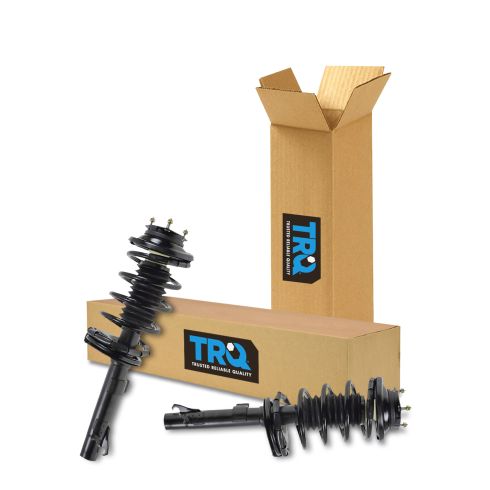
TRQ fully loaded shocks and struts are manufactured using premium raw materials and calibrated to restore original ride comfort. TRQ shocks are fully loaded featuring a pre-loaded bearing plate, upper and lower spring isolator, upper spring seat, coil spring, boot kit, and premium strut. TRQ recommends replacing your shocks or struts in pairs to ensure even wear of components and improved ride comfort. All products are fit and road-tested in our Massachusetts R&D facility to ensure we deliver on our promise of Trusted Reliable Quality.
Replacing struts used to require specialized tools to compress, remove, and transfer the old spring and mount. Our Pre-assembled, complete strut & spring assemblies come with all new parts and make the job much quicker and easier for the do-it-yourself mechanic.
Strut & spring assembly contains:
Attention California Customers:
 WARNING: This product can expose you to chemicals including Lead and Lead Compounds, which are known to the State of California to cause cancer, and birth defects or other reproductive harm. For more information, go to www.P65Warnings.ca.gov.
This part fits 8 vehicles spanning 2000-2005.
| Year | Make | Model | Description |
|---|---|---|---|
| 2000-2001 | Ford | Focus | Ford Focus Front Driver & Passenger Side 2 Piece Strut & Spring Assembly Set TRQ SCA56955 |
| 2002-2004 | Ford | Focus | Ford Focus ZX5 Front Driver & Passenger Side 2 Piece Strut & Spring Assembly Set TRQ SCA56955 |
| 2002-2004 | Ford | Focus | Ford Focus ZX3 Front Driver & Passenger Side 2 Piece Strut & Spring Assembly Set TRQ SCA56955 |
| 2002-2004 | Ford | Focus | Ford Focus ZTW Front Driver & Passenger Side 2 Piece Strut & Spring Assembly Set TRQ SCA56955 |
| 2002-2004 | Ford | Focus | Ford Focus ZTS Front Driver & Passenger Side 2 Piece Strut & Spring Assembly Set TRQ SCA56955 |
| 2002-2004 | Ford | Focus | Ford Focus SE Front Driver & Passenger Side 2 Piece Strut & Spring Assembly Set TRQ SCA56955 |
| 2002-2004 | Ford | Focus | Ford Focus LX Front Driver & Passenger Side 2 Piece Strut & Spring Assembly Set TRQ SCA56955 |
| 2005 | Ford | Focus | Ford Focus Front Driver & Passenger Side 2 Piece Strut & Spring Assembly Set TRQ SCA56955 |
| Brand Label | Part Number |
|---|---|
| KYB | SR4028 |
| KYB | SR4027 |
| Monroe Shocks & Struts | 181505 |
| Monroe Shocks & Struts | 181504 |
| Monroe Shocks & Struts | 171505 |
| Monroe Shocks & Struts | 171504 |
| Gabriel | G57063 |
| Gabriel | G57064 |
| Unity Automotive | 11062 |
| Hollander | 527-01413R |
| Hollander | 527-01414L |
| Unity Automotive | 11061 |
This item may be interchangeable with parts from other brands with the above part numbers. This information is provided only for reference and does not guarantee that the item you are purchasing is identical to parts with part numbers from the brands listed above. To confirm that this item fits your vehicle, use the above "Check Vehicle Fit" option.
Lifetime Warranty
This item is backed by our limited lifetime warranty. In the event that this item should fail due to manufacturing defects during intended use, we will replace the part free of charge. This warranty covers the cost of the part only.
FREE Shipping is standard on orders shipped to the lower 48 States (Contiguous United States). Standard shipping charges apply to Hawaii and Alaska.
Shipping is not available to a P.O. Box, APO/FPO/DPO addresses, US Territories, or Canada for this item.
Expedited is available on checkout to the United States, excluding Alaska, Hawaii.
Final shipping costs are available at checkout.

Created on:
Tools used
Brought to you by 1AAuto.com, your source for quality replacement parts and the best service on the internet
Hi I'm Mike from 1A Auto. I hope this how-to video helps you out and next time you need parts for your vehicle, think of 1AAuto.com, thanks.
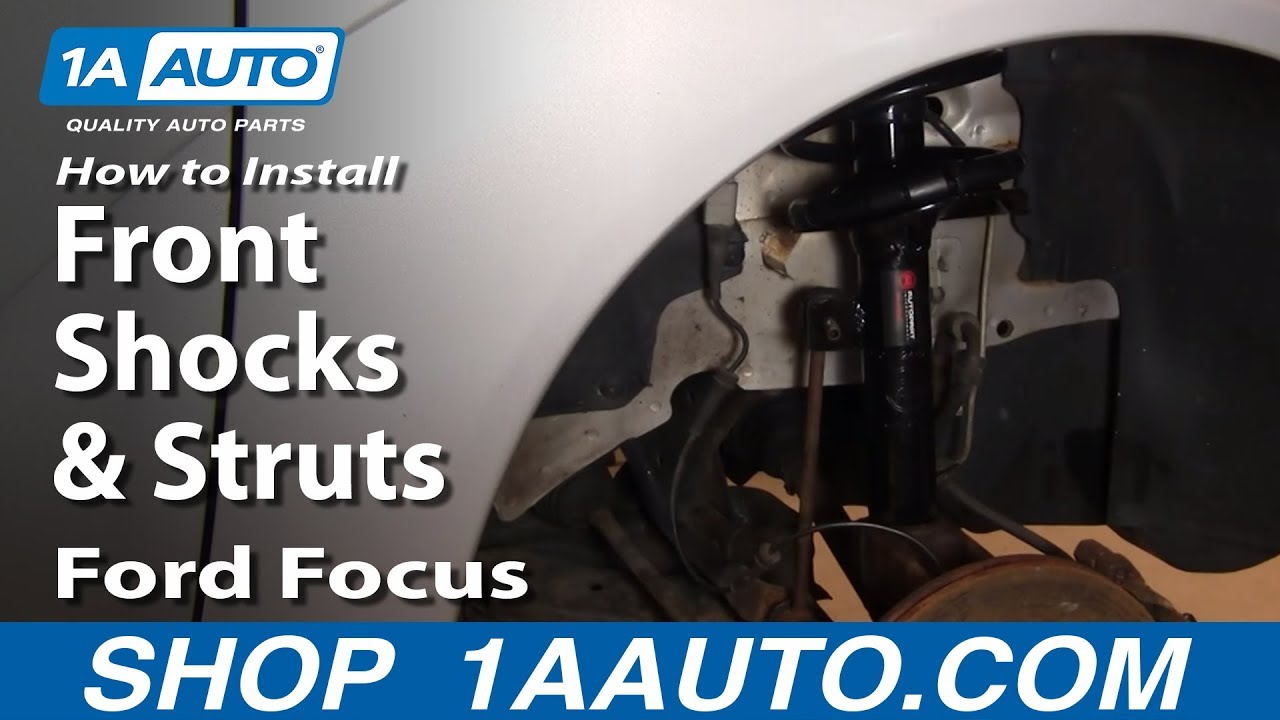
In this video, we're going to show you how to replace a front strut and spring assembly on this 2003 Ford Focus, pretty much the same for any 2000 to 2011 Focus. We're going to show you the passenger's side. The driver's side is basically the same procedure. We do always recommend that you replace your struts in pairs.
You'll need new struts from 1A Auto, jack and jack stands, 13 to 19mm sockets with all the accompanying ratchets, extensions and you'll need a breaker bar or pipe for some extra leverage, large hammer. You may need to get off the stabilizer link and nut, you may need a 17mm wrench with a T30 Torx driver. You'll also need some penetrating oil and a torque wrench to put everything back together correctly.
Remove the wheel and tire. You can use your lug wrench that comes with the vehicle. If you're using your lug wrench and hand tools, you want to have the tire on the ground. Loosen the lug nuts first, then raise and support the car and remove the lug nuts. You will need kind of a thin walled socket. Regular impact sockets don't really fit in here.
I'm going to fast forward as I remove the lug nuts, and then, actually, I realize the wheel is stuck on so I thread two lug nuts back on and use a little bit of an alternative method to remove the wheel.
Underneath here, you want to detach a couple of things, the break line pull that out of that bracket. Your ABS sensor, pull that out of here and out of the way. Then, we're going to remove this bolt that holds the upper stabilizer link. First, we're going to spray with some penetrating oil. When we spray that one, we're going to spray the one down here as well that holds the bolt right here that pitches on to the strut and we're going to try to spray the back side of that as much as we can.
Now, a 17mm wrench and put on there and we're going to then hook up the 18mm wrench on like this. It gives us more leverage and we're going to see the nuts actually coming off. What you can do is I have a T30 Torx Driver here. If this starts spinning, just insert that in there and we can hold it steady. It's coming off okay, then hammer. Next is the bolt that holds the strut into the steering knuckle right there. It's a 15mm. Then put a socket with an extension on it to get it clear of this break line. If you have a breaker bar like this, you want to use that. If not, you can use your ratchet. Just use a piece of pipe to give you some extra leverage. I'll just fast forward. You want to take that bolt all the way out. Just spray some penetrating oil where that strut goes in to the steering knuckle.
Get a 15mm socket and disconnect your tie rod in here. The best way to do it is keep the nut as close right up flush with the stud and tie rod. I'm going to repeat the hammer. Once you break the tie rod loose, the stud will start spinning in it so what I did is I took some wood and my jack, jacked up the tie rod into the steering knuckle that holds it in place. I can remove the nut the rest of the way, and then I should just take a light tap and knock the tie rod back out. This vehicle has a broken spring so I actually have lift up on the strut and then hit the steering knuckle until everything comes loose. Then I force the strut up and take the strut out of the steering. Up in the engine compartment, there are three 13mm bolts and they usually come out pretty easy and sometimes they actually break but that's not a big deal if they break off, your new strut assembly comes with new ones.
You can see. Problem with our old strut, right there, a broken spring, not uncommon on these vehicles. This strut is from 1A Auto. It comes all assembled as one piece with the coil spring already on there. It makes it easy to install. I'll remove these. You'll want to put that up in there. I'm going to put it up in there so that this is to the inside. I'm just going to put it in and through here. Take a peek here, just looking at the studs, get them up through. They come up through. Put these bolts on and the nuts. Tighten up the nuts in there. Remember to tighten that with this. Now, continue to be really careful of this harness here. Take care of your strut and your suspension when you're getting that strut right in that groove there. Pull along the strut and pull the steering knuckle out. Push everything together. Now, put a bolt that pinches the steering knuckle back on to the strut in and push on it with your wrench and start it in but don't tighten it yet.
Now, you want to make sure that before you tighten this bolt up, okay, you want to make sure your strut is in the right position. Basically you want to have it so the inside here is just below and then the outside is just flush. The strut is actually indented. You don't want to be too high on the strut. I can probably show you better on this strut here. You can see that the strut comes out and you want to be down below. Your taper is here and you want to make sure you're down below the taper where you tighten it up.
The strut and steering knuckle move around, let's make sure we have it at the right depth. Then use a torque wrench to tighten this bolt between 65 and 70 foot. You're going to put this break back in place, and take your tie rod in and put the wheel over, the tie rod back up in and just kind of put the nut on the tie rod for now to kind of hold it in place and then the stabilizer link here. Get it through. Put this strut back on. As you tighten this up the stud is not spinning, put that back in place. Put that back in place up here. I'm going to fast forward here as I use a jack. Jack the tie rod right on to the tie rod, up into the suspension that holds the stud in place in the steering knuckle. Then you tighten up the nut and torque it to 55 to 60-foot pounds. Put the wheel back on.
I'm going to fast forward here. Put the wheel on. Make sure you thread the lug nuts on a few turns, finger-tight just to make sure that they're not cross threading. Then tighten your lug nuts up preliminarily and then you're going to put the vehicle on the ground and torque the lug nuts. You want to torque the lug nuts to a 100-foot pounds and give me a crossing pattern.
These nuts up here, torque between 25 and 30-foot pounds.
We hope this helps you out, brought to you by www.1AAuto.com, your source for quality replacement parts and the best service on the internet. Please feel free to call us toll free, 888-844-3393. We're the company that's here for you on the internet and in person.
Tools used
Hey friends. It's Len here at 1A Auto. Today I'm working on a 2001 Ford Focus and I'm going to show you how to do a front strut. It's going to be a very simple job. I want to be the guy that shows you how to do it. If you need this or any other part, you can always check us out at 1AAuto.com. Thanks.
Okay, friends. We've got the vehicle supported under all its lift points. We're going to bring the vehicle up a little bit. Try to keep the wheels so it's just barely touching the ground. We're going to break free the lug nuts, 19 millimeter. If you're going to be using an air gun, you really shouldn't have to do this, but if you're using a ratchet, you want to do it with the wheel still touching the ground. Now that they're loose, we can raise the vehicle and we'll get busy.
Here we go. Time to get the wheel off. Use your ratchet, use your air gun, use your 19, whatever you're doing. When I take off the last one, I'm going to hold the wheel. It's nice and corroded on there. Just put one of these lug nuts back on. Just going to give this a little bonk, see if we can get it to break free. Feels like a no. Okay. Something else that we can try doing, just grab a pry bar or you can use a rubber mallet if you wanted to. I use a pry bar and I just come from the back side, pry up against the lower control arm and the wheel. Use a little leverage break it free. Easy peasy. Some people might try to use a hammer. You could dent your wheel, rubber mallet could work. All right, we removed the wheel, now we have a clear view of what we're working on.
One of the first things we got to do here is we got to get the stop off of the strut. We're going to be taking the strut out, this unit right here, it's got the spring on it. When you take the brake hose off of here, it should just slide right out. Okay. It's always a good habit to spray everything down with some penetrant spray as well because that's going to help soak in because what we're going to have to do is we're going to have to take this nut off right here, pop the sway bar link out of the way. We're going to remove this bolt right here. This is the pinch bolt. It squeezes your knuckle around your strut. Once we get this off, we'll move ahead to this one. And then once we get that all off, we'll go ahead and give this a couple bonks, see if we can drive it down. Once we get it so it's separated, we'll be able to go up top and finish up taking the strut out.
What I'm going to do here, I'm just going to use some locking pliers. I'm going to try to grab the backside of this sway bar link, try to hold onto it, then I'm going to use a 15 millimeter, try to remove this nut right here. Can use a ratchet or whatever you want to do. If you have access to an air gun, it's definitely helpful. We sell them at 1AAuto.com, by the way. There's that. We've got our brake hose out of the way. It's going to have plenty of slack, so when we swing our knuckle down, once this breaks free, it won't put a tug on our brake hose. See what size this bolt is. It's a 15 as well. Safety glasses, of course.
This is our pinch bolt. If you take a look at it and it looks like it's corroded and rotted away, you'd want to replace this. All right. This one looks like it's pretty good. Just a little rusted. I'll go ahead and clean it up before I reinstall it, but I'd say that this one's still reusable. I'm going to set this aside. We'll move along.
Here we go, little bit more penetrant. Cool. You're going to take your hammer. You're going to try to bonk right on this knuckle right here. Just give it a couple of bonks. Bonk, bonk. See if you can get your break free. I'm going to bring it down to a working level. This a little bit high for me to try to swing. I don't want to hit the fender. It's a beautiful fender, so I'm going to bring it down and then I'll show you what I'm talking about.
Okay. We can go ahead and bonk right on here. If you felt the need, you could take a lug nut, just put it on here. We still have the brakes attached so the rotor really can't go anywhere. But if you want to make sure that the rotor doesn't move around, very much, couldn't hurt to just throw that on there. That's going to help prevent the rotor from moving around and rust falling down in between the rotor and the hub. Looks like it's starting to slide down, swing a little harder if I want to. I just want to be careful. Like I said, I don't want to hit the fender.
Yep, that looks pretty good. Looks like we're cruising along. Still got quite a bit to go though. It feels like we're about, maybe about halfway up that knuckle. Right about here is where the strut ends. What I'm going to do, I'm going to remove this axle nut right here. I'm going to try and push the axle through a little bit. I don't want to put too much pressure on the axle itself, so I'll grab the a socket for that. I'll tell you what it is. We'll remove it, we'll try to drive the axle in a little bit. 32 millimeter.
Here's our axle nut. We'll set this aside. If you don't have an air gun, impact gun to take the axle nut off, you can do something like this with a pry bar. You just kind of stick it in between the studs just like that and up against the ground, assuming you had the vehicle lower, that's going to help prevent your a hub and everything from turning. Now over there you could put your socket with your long ratchet on there, you can relieve pressure or take off the nut without spinning your whole hub. That'll just hold it still for you. I just want to give you a heads up on that.
This is our air chisel available at 1AAuto.com. Performance tool, it's going to work pretty good. All we're going to do is we're going to use a center punch bit. Try to go right in that hole, apply pressure and just air chisel it. Get it to vibrate, push the axle in a little bit, and that should give us a little bit of slack to continue with what we're doing here.
That was easy peasy. All right, let's continue with the bonking. Getting pretty close now. You have access to a pry bar, all I'm going to do is I'm going to try to lower this down a little bit, just like that. All right, so that's all nice and free. You want to be careful pulling this out because you can separate your axle joint like that and that'll cause an issue. At that point you'd want to replace it. I'm going to be replacing the axle in one of these videos anyway, so you might see it magically become new, but that's what you're going to do.
I lowered the vehicle down. Now we're going to start working from the top. I'm going to spray down the three nuts that we're going to be removing. One, two, three. Do not touch the center one. Do not touch it. One, two, three. I'm going to use the 13 millimeter to remove these nuts. One, two, third one the struts going to want to fall down so you can just reach underneath, hold it up if you want. Set those aside. Strut should come down. Now we've removed our left front strut.
Here we go friends, a quick product comparison for you. Over here we have our original strut from our 2001 Ford Focus. We just tore it out, easy peasy. Over here we have our brand new quality 1A Auto part. As you could tell, they're both shaped the exact same. You've got your flex hose point right here. You've got this part that goes into where your knuckle is. On the other side, you've got your spot for where the sway bar link goes through. It's the same thing on this strut. They're both the same height. Very important. You want to make sure that you have them both the same height. If your old one sits this high and your new one's that low, well, you're going to have a ride height issue, aren't you? They're built to the same exact quality specs. Everything's the same. You got your coils, brand new coil springs, brand new dust boot dampener and everything. This right here is a little John's bumper. In case you happen to hit something real hard and you condense this all the way, you won't bottom it out completely.
Up top, got your strap mount. Brand new. You don't have to worry about replacing it. You never want to touch this nut. Just leave that alone. It comes with brand new mounting nuts for where it connects to the body of the vehicle. With all that said, I don't see any reason why this wouldn't be a quality part to install into our vehicle, so I'm going to go ahead and do it. If you need this or any other part, you can always check us out at 1AAuto.com. Thanks.
Okay, friends, time for the install. We're going to take off our nuts. We got new ones, so let's use them. We'll make sure that we recycle our old ones properly. There we are. Now what we're going to do, is we're going to come from under. Put it in just the way we took it out. Kind of shooting in the dark here. I'm going to get these studs lined up. These are locking nuts, so you won't be able to screw them down til they're bottomed out, by hand at least, obviously with your ratchet you can. There we are. Cool. All right, so let's snug these out. Snug them up. We'll torque them up. Once we get the weight of the vehicle on it, that'll really press it in nice and tight and then we can torque them. Okay, so let's snug them. Let's see if I can find my air gun. 13 millimeter, safety glasses, of course. We'll torque those up in a little bit.
On here, now what we need to do is we need to get our pry bar inside here. We're going to lower down the lower control arm. It's going to bring down our knuckle a little bit. We should be able to slide this right in. Before we do that, we'll grab our copper Never Seize again. Safety glasses. Good to go. I'm going to grab my pry bar. Come around this way a little bit. Just going to try to press down. Hopefully I can get my knuckle down low enough so I can get my strut in there. Sometimes it can be little difficult. Obviously, watch for pinch points. Safety first. I can't see what you're doing.
Just get stuff wiggling around here a little bit. I've got my jack. Just going to put it underneath the ball joint area. Going to try to jack this up. Sometimes it just takes a little bit of maneuverability here, a bit of brute force. Make sure it's lined up and it is. It's going. It's just a nice tight fit.
Now that I've got the knuckle pushed all the way up and the hole for the knuckle and the strut are lined up, I can use my pinch bolt, can use a little bit of thread locker if you'd like. It's up to you. I'm going to wear my safety glasses of course, because I'm using a air gun here. We're going to torque that down. Next what we can do, put that on there. We'll get our jack out of the way here. We'll go get that torque spec and we'll be able to move along.
For the pinch bolt right here, you want to go 66 foot pounds with your 15 millimeter. There we are. Just going to hit it one more time real quick. Torqued, 66 foot pounds with my 15 millimeter. We've got our axle nut, just going to start it on here. We'll get a few good threads. Make sure it's going on. Now we're just going to blast this on but we don't want to go too tight. We just kind of want to get it so it's close to bottomed out and then stop because we're going to torque this down. Here we are. 32 millimeter socket. Looks like it's getting pretty close. I'm going to leave it there for now. We'll go ahead and torque it down and that'll get it to the correct specifications. You don't want to over tighten this, ruin the bearing we just put in there.
Let's get our sway bar link. There we are. We got our nut. 15 millimeter. I'm just going to hold the backside there with some locking pliers. Tight. Perfect. All right, let's move along.
Okay, friends, we've got the vehicle on the ground. We've got the weight of the vehicle pressing down or pressing the strut cap up against the body of the vehicle, so now we can go ahead and torque this down. The torque for these is 18 foot pounds. We're going to use a 13 millimeter socket. We are not touching this center nut. Let's start here. There we are. Okay, I'm going to hit them again. There we are. Easy peasy.
Let's take off that stabilizing lug nut that we throw on there. We'll grab our wheel, bring it over. I'm just going to lift it right up with our leg, use our ab muscles. Hold the wheel, put our lug nut back on here. I'm going to grab the other three. Time to go ahead and tighten up these lug nuts. 100 foot pounds. We're going to go in a crisscross pattern, never around in the circle. Let's do it again. Tight. We're going to go ahead and torque this down. 266 foot pounds using my 32 millimeter socket. Getting close. Tight.
Thanks for watching. Visit 1AAuto.com, your place for DIY auto repairs, for great parts, great service, and more content.
Great quality and the correct part. Very satisfied
Ordered a set of shocks when i received them the package it was destroyed by UPS! And one was missing. I called 1A auto and talked to Marie, she was most helpfull got me a replacement set and received them 2 days later!!! Great job Marie
Part works good. One strut was received damaged from shipping, but I contacted 1a auto and they sent me a new one without any hassle. Would definitely use 1a auto again in the future
These went in well perfect fit. I dont know how long they will last though due to fact Im writing review just after installing. But seem like quality, cant beat the price for sure. I suggest always doing both, even if just one is bad. Only issue I had with this was shipping, not packed right and the bracket that holds brake line poked through boxes and bent during shipping and had to hammer into proper position. Glad it was just that... Keep calm and Happy repairing, ?? Katie
Struts are quality product and perfect fit ! Very fair price and instalation videos are a great help!
These fit perfectly and work great, makes the ride much smoother in the ole focus. Also much cheaper than every other place I looked, in store it online.
Purchased this product because all the videos on YouTube look super DIY and they were easy to install that is if you have the proper tools. Thank-you 1aauto I will be ordering more stuff for my car soon..... After 14yrs I finally swapped out the original shocks and struts so now my car feels new again
Perfect just what I needed and easy to install. I mean I am no mechanic and wouldn't dream of putting in struts if they didn't come fully assembled. I'm now a customer off 1A auto.
You folks are awesome! Both parts and customer service were graet! I will highly recommend your company. Thanks you so much!
The struts and shocks seem to be of good quality and they fit right in. The customer service was terrific and Rachelle (?) was very helpful kind and pleasant to deal with. Plus she remembered me when I called and placed another order later. I will be doing more business with your company because of that alone! The parts also were delivered promptly as promised. Another good quality are the install videos, they are well done and informative.I have been watching for a long time for various repairs. Thanks 1a auto!

SCA56955
