Replaces





Frequently bought together
Part Details
About TRQ:
TRQ is a trusted brand dedicated to making every repair a success story by combining premium parts with easy installation. Each TRQ part is engineered by a team of automotive experts to meet or exceed OEM standards, delivering enhanced performance and maximum longevity. With rigorous in-house testing, the brand ensures superior fit and function across every product line. TRQ also provides customers with best-in-class, step-by-step installation videos—so you can complete repairs with confidence, whether you're a first-time DIYer or an industry professional.
Product Features
Product Features
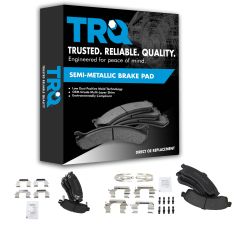
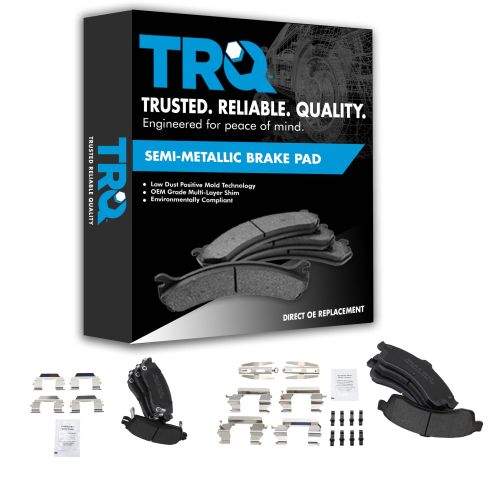
TRQ brake pads are manufactured using premium raw materials and design standards to restore original performance. TRQ brake pads are positive molded and utilize a multi-layer shim for enhanced performance and service life. TRQ’s combination of materials and design ensures a low dust and low noise braking experience. TRQ recommends replacing your brake rotors when you replace your brake pads to ensure even wear of components and improved braking comfort. All products are fit and road-tested in our Massachusetts R&D facility to ensure we deliver on our promise of Trusted Reliable Quality.
Attention California Customers:
 WARNING: This product can expose you to chemicals including Lead and Lead Compounds, which are known to the State of California to cause cancer, and birth defects or other reproductive harm. For more information, go to www.P65Warnings.ca.gov.
Lifetime Warranty
This item is backed by our limited lifetime warranty. In the event that this item should fail due to manufacturing defects during intended use, we will replace the part free of charge. This warranty covers the cost of the part only.
FREE Shipping is standard on orders shipped to the lower 48 States (Contiguous United States). Standard shipping charges apply to Hawaii and Alaska.
Shipping is not available to a P.O. Box, APO/FPO/DPO addresses, US Territories, or Canada for this item.
Expedited is available on checkout to the United States, excluding Alaska, Hawaii.
Final shipping costs are available at checkout.
Created on:
Tools used
Brought to you by 1AAuto.com, your source for quality replacement parts and the best service on the internet.
Hi, I'm Mike Green. I'm one of the owners of 1A Auto. I want to help you save time and money repairing and maintaining your vehicle. I'm going to use my 20+ years' experience restoring and repairing cars and trucks like this to show you the correct way to install parts from 1AAuto.com. The right parts installed correctly, that's going to save you time and money. Thank you and enjoy the video.
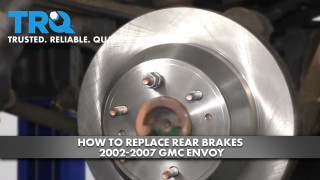
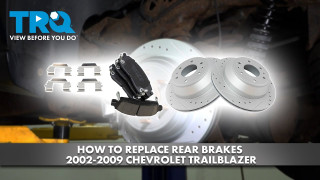
In this video we're going to show you how to change the rear brakes on this 2004 Trailblazer same as most '02 to '09 GM mid-size SUV; the Trailblazer, Envoy, Bravada, Ranier, Saab 97x as well as the Isuzu Ascender. Tools you'll need: various size millimeter sockets with a ratchet, you'll want a breaker bar or a pipe for some extra leverage, two M10 x 7cm bolts, jack and jack stands, flat blade screwdriver, and a large C-Clamp, as well as a wire brush.
Rear tire, lug nuts are 19mm. If you don't have air tools you want to start with the vehicle on the ground, loosen the lug nuts, raise it, support it with jack stands, and then remove the lug nuts. I'll fast forward here as I remove the rest of the lug nuts and remove the wheel.
To check the condition of your brakes what you want to do is look right into this access hole and I'm going to turn the rotor a little bit so you can see the rotor. Right next to the rotor you can see the pad and it has a small hole there and even on the other side is a small hole. That hole is actually your wear indicator and since you can still see the hole that means that the pads actually have some more wear left probably on this vehicle another five or ten thousand miles. And then you also want to check the condition of your rotors, and you just want to run the back of your finger up and down just make sure that there's no deep grooves or anything in the rotors and even though these rotors look a little bit rusty it's just because the car hasn't been used a lot.
One thing we're going to do is take a large screwdriver and just carefully pry out on our caliper. That just gives us a little room to get it off and then the caliper is held on by two 14mm bolts, one down low and then one right up high. We'll fast forward through loosening and removing those bolts. They should come out pretty easy because you only tighten them up to about 15 to 20 foot pounds. Now the caliper comes right off, and you can use your screwdriver to pry out the pads.
Now to remove your rotors you're going to have to remove this bracket and there's two bolts; one here and one here. These bolts are 18mm. Always good if you're doing your own work to have a little piece of pipe around if you don't have a breaker bar because you're going to want to put your ratchet on here. These bolts are usually tightened to anywhere from 90 to 100 foot pounds. Just put your pipe on the wrench and then just go slow and easy apply pressure and loosen up the bolt. Now our other bolt, the sway bar is kind of in the way so what I'm going to do is take the 18mm wrench and then I'm going to hook my 17mm or just another wrench on here put them together like that. This gives me some extra leverage again. And again, pull nice and easy and slow and you'll break it free.
We'll speed it up here again as I use the wrench and the ratchet to remove those two 18mm bolts the rest of the way. That bracket comes off. Now if you're lucky pull your brake rotor right off. I'm not quite that lucky. I have two I believe these are either M10 or M12 bolts. Thread them right in. 17 mm heads. That will just help you get it out some, and that comes right off. So you might notice I've got a nice new backing plate and a new wheel stud on here. You can check out our other videos to see how I did those. The new disc from 1AAuto fits right on nicely. Now you'll want to reinstall your bracket. The bolt goes through and into the back of the axle. So, I've got my bolts preliminarily tightened. I'm going to use a torque wrench to tighten them to 90 foot pounds.
Before you go to put the brake pads on you want to make sure of a couple of things. These should slide back and forth nice and easily, nice and free. If they don't you can actually just pull them right out, clean them up and grease them and make sure that they move freely. Then these slides just kind of pull off and you want to take a wire brush and clean them out. So I've cleaned up this one and you don't have to get them perfect just get them cleaned out a little bit. Press them back into place, and now the new pads from 1AAuto, push them down in. They push into place. Same thing with the rear one here, push it down in. Push it in place.
So now if you go to put the caliper on you're going to find it doesn't fit, and that's because this piston has worked its way out as the pads wear. Just take an old pad put it right down, a nice big C-Clamp here. I'm going to use this C-Clamp to slowly push the piston back in. Make sure you work this gasket in, and now your caliper quite easily works down onto the new shoes, bolts in. Just going to fast forward as I just put those bolts in and preliminarily tighten them. You may find when you're tightening them you want an adjustable wrench or this looks like probably about a 15mm and you can just hold on to this nut right here. Mine seem to be going together pretty easily, and now we're going to torque those bolts to 20 foot pounds.
Now we are going to fast forward as we put the tire back on then start each one of the lug nuts by hand. You do want to make sure that you don't cross thread them, and then using our air wrench just preliminarily tighten the lug nuts. And now with the vehicle on the ground, torque the lug nuts to 100 foot pounds each, and please stay tuned to the very important last step which is to pump your brakes up before you try and road test your vehicle. And last but not least, you want to pump your brakes a bunch of times until you feel your pedal firm back up before you road test your vehicle and you can then just try and make sure you do a stop at five and ten miles an hour before going out on the road.
We hope this helps you out. Brought to you by www.1AAuto.com-- your source for quality replacement parts and the best service on the internet. Please feel free to call us toll free, 888-844-3393. We're the company that's here for you on the internet and in person.
Tools used
Brought to you by 1AAuto.com, your source for quality replacement parts, and the best service on the Internet. Hi, I'm Mike Green. I'm one of the owners of 1AAtuo. I want to help you save time and money repairing and maintaining your vehicle. I'm going to use my 20 plus years experience restoring and repairing cars and trucks like this to show you the correct way to install parts from 1AAuto.com. The right parts, installed correctly. That's' going to save you time and money. Thank you, and enjoy the video.
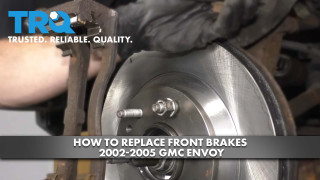
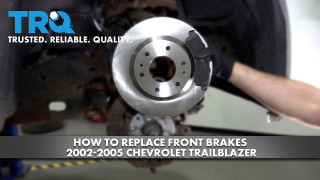
In this video we are going to show you how remove and replace the front brakes on this 2004 Trailblazer, same as any '02-'09 Trailblazer, as well as the other GM SUVs Envoy, Bravada, Rainier, Saab 97X, and Isuzu Ascender. The extended vehicles have a little bit different brakes, but the procedure is basically the same. Tools you'll need for this job are 13, 18, and 19mm sockets or wrenches, a breaker bar or pipe if you need some extra leverage. On this vehicle actually I actually didn't even need either one of those, but maybe you do if your vehicle is a little stubborn coming apart, a flat blade screwdriver, wire brush, a large C-clamp, and a torque wrench. You're going to start by prying your cap off. That's your 19mm. If you don't have air tools, you'll want to start with the wheel on the ground. Loosen the lug nuts, and then raise it. Support it with jack stands, and then remove the wheel and tire. And I'll just fast forward taking off the rest of those lug nuts, and then removing the wheel and tire. Now either pull, or using the steering wheel turn your wheel so you have easy access to the back of the brake calipers. Now we can check the condition of the brakes.
When I spin this you'll see the rotor move. Okay, so then right to the right there is actually your pad. And you can see there's not that much life left and not a whole lot on the outside either. So, we're going to remove the caliper, which is removing a bolt up here, and a bolt down here. And then after that, we're going to remove the caliper bracket, which is 2 large bolts-18mm one here, and one up here. Okay the bolts go in the caliper relatively easy, 13mm. Use a small wrench. And we'll just speed it up here as I remove those 2 bolts. Okay, the caliper comes right off, and we'll set it over here. Okay, these are 18mm bolts. For the caliper bracket you're going to want a breaker bar, which is a bar to give you extra leverage. Okay, they actually come apart pretty easy. If you don't have a breaker bar like this-you just have a ratchet-you can put a piece of pipe on. Kind of gives you extra leverage. And pull nice and easy on the pipe until they come loose. Or take it all the way off. You can take your pads off. Use a screwdriver. It should pretty easily pry out. Okay, you can see this one. That little line down the middle is the wear indicator, and it's actually just about at the end of it's life.
And we'll fast forward again as we remove those 2 18mm bolts that hold that caliper bracket. Okay, once that comes off then your disc should just come off. If your discs don't come off, there are threaded bolts. And you can use some bolts. What you do is you put the bolts in there, and the bolts press against the hub to push them out. Okay, and these rotors-pretty crusty looking-so I am going to replace them. Your disc from 1A Auto goes right on. You want to make sure you don't put these holes where this is, because what those holes are meant to do is if this were stuck, you would use bolts to push it off. Now I can just put a lug nut on just to hold the rotor in place. Okay, before we put our bracket on, just use a wire brush and clean out these stainless steel slides a little bit. Okay, make sure that these slides are nice and free, which they are on this. And put this on. Put the bolt through the steering knuckle first and into the bracket. Torque these to 90 foot-pounds as well. Nice new set of brake pads go right in. Now you want to force these 2 pistons back down into the caliper. So I just put my old brake shoe right in there. Okay and slowly force them back in with a C-clamp. Okay, use some break parts cleaner or mineral spirits. Just get off any dirt that may be on there. Now take a caliper and pull those. Slide it out a little bit, pull it down. Okay, these two bolts, 25 foot-pounds. Okay, fast forward here as I remove that lug nut that I used to hold the disc in place. I put the tire back on. Start all the lug nuts by hand first, and then I'll tighten them up preliminarily with my wrench and torque them when it's back on the ground. And with the tire back on the ground, I'm going to torque the lug nuts to between 100 and 120 foot pounds, kind of just using just a crossing pattern. Very important, after doing break work, always pump your brakes many times. And then before you do a road test make sure the brakes hold the vehicle in gear, and then do a stop from 5 miles an hour and 10 miles an hour before hitting the brakes.
We hope this helps you out. Brought to you by www.1AAuto.com , your source for quality replacement parts and the best service on the Internet. Please feel free to call us toll free 888-844-3393. We're the company that's here for you on the Internet and in person.

BFA12935